Market Update: 16 November 2026

Monday 16 November 2026, 09:30 AEDT. Commentary from the Neo-X OTC Desk and the Neo-X Market Making Desk. This issue is about flow. Wholesale clients only. All figures are illustrative and are not quotes.
At a glance

Bitcoin traded through US$62,000 on Sunday and sits near US$65,100 this morning, down about 13% on the week, with roughly US$2 billion of leveraged positions liquidated in 24 hours and seven straight sessions of US spot ETF outflows (Farside via crypto.news, 15 Nov). The US 10-year yield closed Friday at 5.15%, about 30 bp higher on the week, with a December Fed hike fully priced and a 50 bp move carrying roughly 13% (CME FedWatch via Motley Fool, 14 Nov). The Australian dollar fixed at 0.6785 on Friday (ECB), a 90-day low. On the desk, the week split in two: stablecoin-for-AUD flow at two to four times a normal day through Friday, then a weekend of small, all-buy BTC/AUD tickets into the low. Gold held near US$3,880 after Thursday's 13-month low and Brent settled at US$95.84.
Markets
Bitcoin. Kraken BTC/USD was US$65,112 at 09:30 AEDT (Kraken ticker, 15 Nov UTC; Coinbase spot US$65,121), down 12.9% on the week, 20.1% over 30 days and up 1.0% over 90 days. The 24-hour range on Kraken was US$61,970 to US$66,087. Sunday's low, which several outlets put between US$62,006 (Binance print) and US$62,112 (Bloomberg data), was the lowest since mid-July and sits below the 200-week moving average near US$67,900 (The Crypto Desk, 15 Nov; crypto.news, 15 Nov). CoinGlass counted about US$1.96–2.02 billion of liquidations in 24 hours, roughly US$750 million of it in BTC and about 80% of that longs, after about US$1.3 billion on Friday (crypto.news and Blockonomi, both 15 Nov). US spot bitcoin ETFs recorded their seventh consecutive outflow session on Friday, US$185.4 million (IBIT US$143.5 million), for about US$1.91 billion over 5–13 November (Farside via crypto.news, 15 Nov). The drivers cited across sources are the same ones that built through last week: a December hike now fully priced after October CPI, the semiconductor sell-off and associated margin calls, MARA's reported sale of 13,597 BTC in October (CoinDesk, 10 Nov), and MSCI's decision to remove Strategy from its global standard indexes at the 30 November close (Cointelegraph via The Crypto Desk, 15 Nov). The 90-day high in the window was US$86,594 on Kraken (21 September).

Ether and ETH/BTC. ETH/USD was US$1,826 (Kraken), down 14.0% on the week and 24.5% over 30 days, after a Sunday low of US$1,711, the lowest since early July (The Crypto Desk, 15 Nov). US spot ether ETFs lost US$398.9 million over 9–13 November (Farside via Blockonomi, 15 Nov). ETH/BTC is 0.0280, down 1.3% on the week and 5.5% over 30 days, and the 11 November low of 0.0276 is still the 90-day floor.

Desk standouts. Over the 30-day window from 12 October (rebased to 100 on Kraken closes), Solana is at 68 (US$72.21, down 16.5% on the week and 32% over the window), Sui at 70 (US$0.734, down 10.5% w/w), XLM at 74 (US$0.141, down 3.6% w/w), HYPE at 83 (US$67.99, down 8.6% w/w) and Tether Gold at 92 (US$3,837, down 5.1% w/w, tracking spot gold). Bitcoin is at 80 on the same basis. Every name in the set is below its 12 October level; HYPE held up best among the alts this week and XLM's weekly loss was the smallest, though it carries the second-largest 30-day drawdown.

Stablecoin supply. Total stablecoin supply fell US$14.2 billion in the 30 days to 9 November, the fastest contraction since June 2022 (Glassnode via The Crypto Desk, 15 Nov); Coinbase Institutional separately put the combined USDT, USDC and DAI decline at a record US$11.5 billion over 30 days (via CryptoTicker, 15 Nov). The two figures cover different baskets and should not be merged.
Equities, oil and the curve. Friday 13 November, New York: S&P 500 7,561.67 (−0.4%), Nasdaq Composite 25,136.27 (−0.9%), Dow 52,347.55 (+0.1%); on the week the three indexes gained 2.5%, 2.3% and 2.1%, the first weekly gain in five weeks (Yahoo Finance/Investopedia, 13 Nov; Cappnotes, 14 Nov). Nvidia fell 2.0% on Friday and about 13% on the week, its sixth straight weekly decline, with Q3 results due after Tuesday's close; AMD fell 8.8% and the Philadelphia Semiconductor Index 3.4% (Cappnotes, 14 Nov). The VIX closed at 19.3. October PPI printed +0.3% m/m against +0.4% expected, 6.5% y/y (Cappnotes, 14 Nov). The 10-year closed at 5.15% (Trading Economics has +1 bp on the day, Investopedia +2 bp, Cappnotes +5 bp; all agree on roughly +30 bp for the week) and the 2-year at 4.86% (Trading Economics, −3 bp; Cappnotes has 4.88%, +2 bp — the direction is disputed and the Trading Economics reading is used in the table). 2s10s is about 28 bp. Gold spot US$3,882 (+0.1% d/d) after Thursday's 13-month low (Trading Economics, 13 Nov). WTI settled at US$88.56 (−0.2%) and Brent at US$95.84 (flat) (Trading Economics, 13 Nov); over the weekend the IRGC Navy claimed two tankers struck mines in the Strait of Hormuz and Bahrain reported drone attacks on Friday and Sunday (ABC News live blog, 15 Nov). ASX 200 closed Friday at 9,082.2 (−0.7%) (Canberra Times/AAP, 15 Nov).
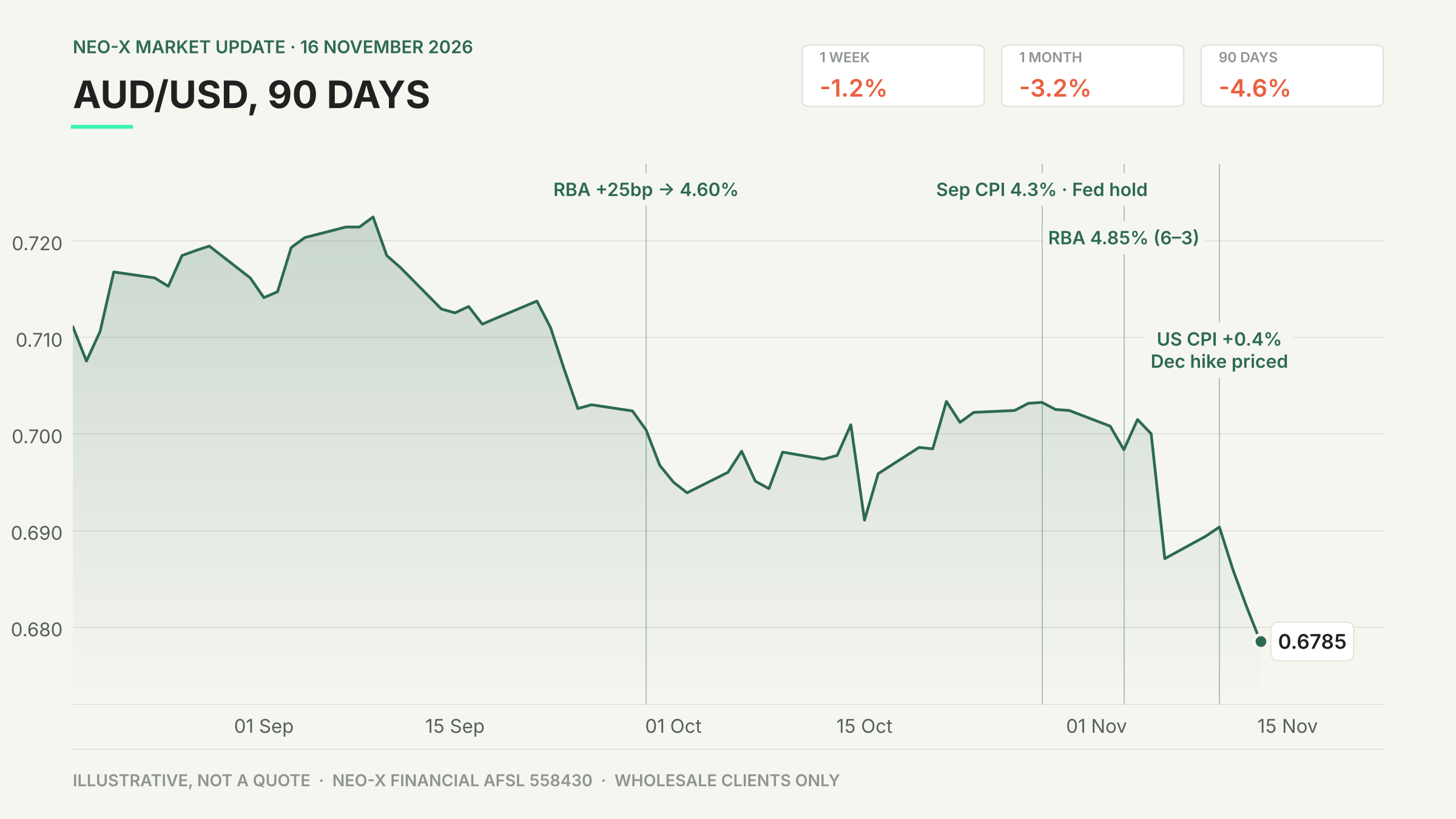
The Australian dollar. AUD/USD fixed at 0.6785 on Friday 13 November (ECB reference, Frankfurter), down 1.2% on the week, 3.2% over a month and 4.6% over 90 days, the lowest fix in the window and, per ABC's Monday morning snapshot (16 Nov), the weakest G10 currency this month; ABC quoted 0.6771 at about 07:00 AEDT. The move is a dollar story as much as an Australian one: DXY closed at 103.4, a 19-month high (Trading Economics, 13 Nov), EUR/USD fell 1.0% on the week to 1.1052 and GBP/USD 1.2% to 1.3227, while USD/JPY fixed at 160.00 (+1.1% w/w). AUD/NZD is 1.2265 (−1.0% w/w), so the AUD lost ground against both the USD and the NZD. The RBA minutes (Tuesday), the September-quarter Wage Price Index (Wednesday) and October labour force data (Thursday) are the domestic inputs this week.
Politics and policy
Australia. The RBA Board's minutes for the 3 November meeting, at which the cash rate rose to 4.85% on a 6–3 vote (RBA MR 2026-30), are due Tuesday 17 November; the Canberra Times (15 Nov) expects them to show how far apart the three dissenters were and notes the Board's November Statement lifted the end-2028 unemployment forecast to about 5.1% from 4.8% in August. Economists expect Thursday's labour force release to show unemployment steady at 4.7% with employment growth above 20,000 (NAB via Canberra Times, 15 Nov), and Wednesday's WPI to print 3.4% y/y against 3.2% in the June quarter. The ABS release calendar confirms the Wage Price Index on 18 November, Labour Force on 19 November, the October monthly CPI on 25 November and September-quarter National Accounts on 2 December, all at 11:30 AEDT. Coles is investigating a cyber-security incident and has told customers to shop as normal (ABC, 16 Nov).
United States. December pricing is settled on direction and open on size: CME FedWatch had a 25 bp hike at 85–89% and 50 bp at 11–15% on Friday, with Kalshi at 91.5% for 25 bp (Trading Economics and Cappnotes, 13 Nov; Motley Fool, 14 Nov). Governor Waller said in London on 10 November that "a 50-basis-point hike in the policy rate should be considered at the December meeting" if core CPI printed 0.3% or more, which it did; Dallas Fed President Logan said at least 50 bp more is needed before a pause, and New York Fed President Williams said on Thursday that further increases were likely (Reuters via Yahoo Finance, 10 Nov; Trading Economics, 13 Nov). Chair Warsh speaks Monday at 12:00 ET (Cappnotes calendar). Congress returns this week with government funding lapsing on 11 December; the President travels to China and Malaysia for the APEC and ASEAN summits with meetings scheduled with Xi Jinping and Vladimir Putin, and Nvidia's former CEO Jensen Huang and Commerce Secretary Lutnick have agreed to testify before congressional committees (Gray DC/KSWO, 15 Nov). On Iran, the US says it is enforcing a naval blockade of Iran's Gulf ports; Bahrain holds Iran responsible for drone attacks on 13 and 15 November and issued its first safety alerts since September (ABC News, 15 Nov).
Regulation. The White House on 12 November sent four nominations to the Senate: Kristin Johnson (D) and Steven Levine (R) for the SEC, and Nathan Anonick (R) and Matthew Rowland (D) for the CFTC; Anonick worked on the CLARITY Act negotiations for Senate Agriculture Chairman Boozman (crypto.news, 13 Nov) [VERIFY against the White House nominations notice]. The CLARITY Act remains stalled after the 15 September procedural vote of 49–50 [VERIFY, secondary source], and the new Congress, with Democratic majorities in both chambers, sits from 3 January 2027. On the primary record: the CFTC filed suits against Louisiana (13 Nov, release 9326-26) and Arkansas (13 Nov, 9325-26) defending its federal jurisdiction over prediction markets after a state court blocked CFTC-regulated exchanges, and the SEC announced its FY2026 enforcement results on 10 November (2026-113) and proposed executive-compensation disclosure reforms on 13 November (2026-114); none of the SEC's five most recent releases is crypto-specific. The CFTC's 5 October advance notice of proposed rulemaking on crypto asset transactions and markets (9307-26) remains the live rulemaking on cftc.gov. In Australia, ASIC's CP 392 consultation closes on 27 November and the Digital Asset Framework Act commences on 8 April 2027, as noted in prior issues; no new ASIC or AUSTRAC digital-asset release was found this run.
What we are watching
- Tuesday 17 November, 04:00 AEDT. Fed Chair Warsh speaks (Monday 12:00 ET). Any comment on the size of the December move matters more than the fact of it.
- Tuesday 17 November, morning AEDT. Monday's US spot bitcoin ETF flow print (Farside), the first test of whether the seven-session outflow run extends after a weekend liquidation.
- Tuesday 17 November, 11:30 AEDT [VERIFY time]. RBA minutes for the 3 November meeting. The split between the six and the three, and what the Board said about a further 35 bp of assumed tightening, set the tone for 8 December.
- Wednesday 18 November, about 08:20 AEDT. Nvidia Q3 results (Tuesday after the US close; revenue consensus US$109.5 billion per Visible Alpha via Investopedia). The semiconductor sell-off is the macro channel most cited for crypto margin calls.
- Wednesday 18 November, 11:30 AEDT. ABS Wage Price Index, September quarter (3.4% y/y expected). A print above 3.5% feeds the RBA's "a little tight" labour-market reading.
- Thursday 19 November, 11:30 AEDT. ABS Labour Force, October (unemployment expected to hold at 4.7%). The RBA's path to 5.1% needs this series to turn.
- Thursday 19 November. Anthropic shares are reported to begin trading (Tom Lee via Blockonomi, 15 Nov); the IPO has been cited as a reason investors are raising cash from crypto.
- Thursday 26 November, 00:30 AEDT. US October PCE (Wednesday 08:30 ET), the last inflation print before the 8–9 December FOMC. ABS monthly CPI for October lands the day before at 11:30 AEDT.
- Tuesday 1 December, about 08:00 AEDT. MSCI's removal of Strategy from its global standard indexes takes effect at the 30 November US close (Cointelegraph via The Crypto Desk); passive selling of the largest corporate bitcoin holder.
- Tuesday 8 December, 14:30 AEDT, and Thursday 10 December, 06:00 AEDT. RBA decision, then the FOMC (Wednesday 14:00 ET). US government funding lapses on 11 December.
OTC Desk
Flow, 9–16 November. The chart reads the desk's own confirmed tickets, each day expressed as a multiple of the median day in the window, with the bar coloured by whether counterparties were net buyers of the asset leg and the dashed line showing the stablecoin share of flow. Monday 9 November was the heaviest day at 3.6 times the median, Thursday and Friday ran at 2.2 and 2.5 times, and Tuesday and Wednesday were ordinary. Through those five days stablecoin pairs were 86–99% of notional and counterparties were overwhelmingly on one side: selling USDT for AUD, with AUD-denominated stablecoins against AUD and USDT making up most of the rest. Counterparty buys were 1–18% of each weekday's flow. The weekend then inverted every one of those readings: Saturday and Sunday were 0.03 and 0.25 times the median day, stablecoins were absent, BTC/AUD was 94–96% of flow, and every ticket was a counterparty buy. Sunday carried more tickets than any other day in the window at about a quarter of a median day's notional, with the median ticket a third the size of the weekday median. Monday morning to 09:30 AEDT continued the pattern, 96% buys, BTC three-quarters of flow.
BTC/AUD through the weekend. The weekend buying clustered between 11:00 and 13:00 AEDT on Sunday, which is when BTC/USD printed its low near US$62,000 (01:44 UTC, CryptoTicker, 15 Nov); the desk's BTC/AUD prints fell from about A$110,000 on the Monday 9 November open to about A$91,700 at 12:45 AEDT on Sunday, a 17% range in AUD terms, and were back near A$96,000 by Monday morning. The buying was broad and small rather than concentrated: ticket sizes over the weekend sat at the bottom of the window's distribution, and no single ticket dominated a day. Thursday 12 November was the only day in the window on which BTC flow was net selling, and Friday's BTC flow was mixed, with one larger sale in the morning and buying through the afternoon as the US close approached. These are observations of the desk's own flow, not a view on direction.
Alts on the desk. Outside BTC, Solana was about half of the window's non-BTC crypto notional, with ETH and XRP most of the remainder and smaller tickets in ONDO, PAXG and SUI. Alt tickets were mostly all buys and almost all on the weekend and Monday morning, in the same small sizes as the BTC buying. Against the 30-day rebased chart above, counterparties were adding SOL at 68 on the index, the weakest of the five standouts.
Liquidity and settlement. Weekend liquidity was thin enough for a US$750 million BTC liquidation cascade to move spot about 6% in a few hours (CoinGlass via crypto.news, 15 Nov), and the Kraken 24-hour range of US$61,970–66,087 is about 6.3% of spot. On a principal RFQ the desk prices from its own inventory and about 25 venues, so a ticket in the usual US$100k–US$20m range is not routed to a single order book; the weekend's flow was almost entirely below that range and was priced and settled on the same basis. Settlement is unchanged: same-day across 27 currencies through the Global Settlement Network, rate first and settle after, with customer assets under custody at Copper. The desk is open 08:00–22:00 AEST with 24-hour support.
Market Making Desk
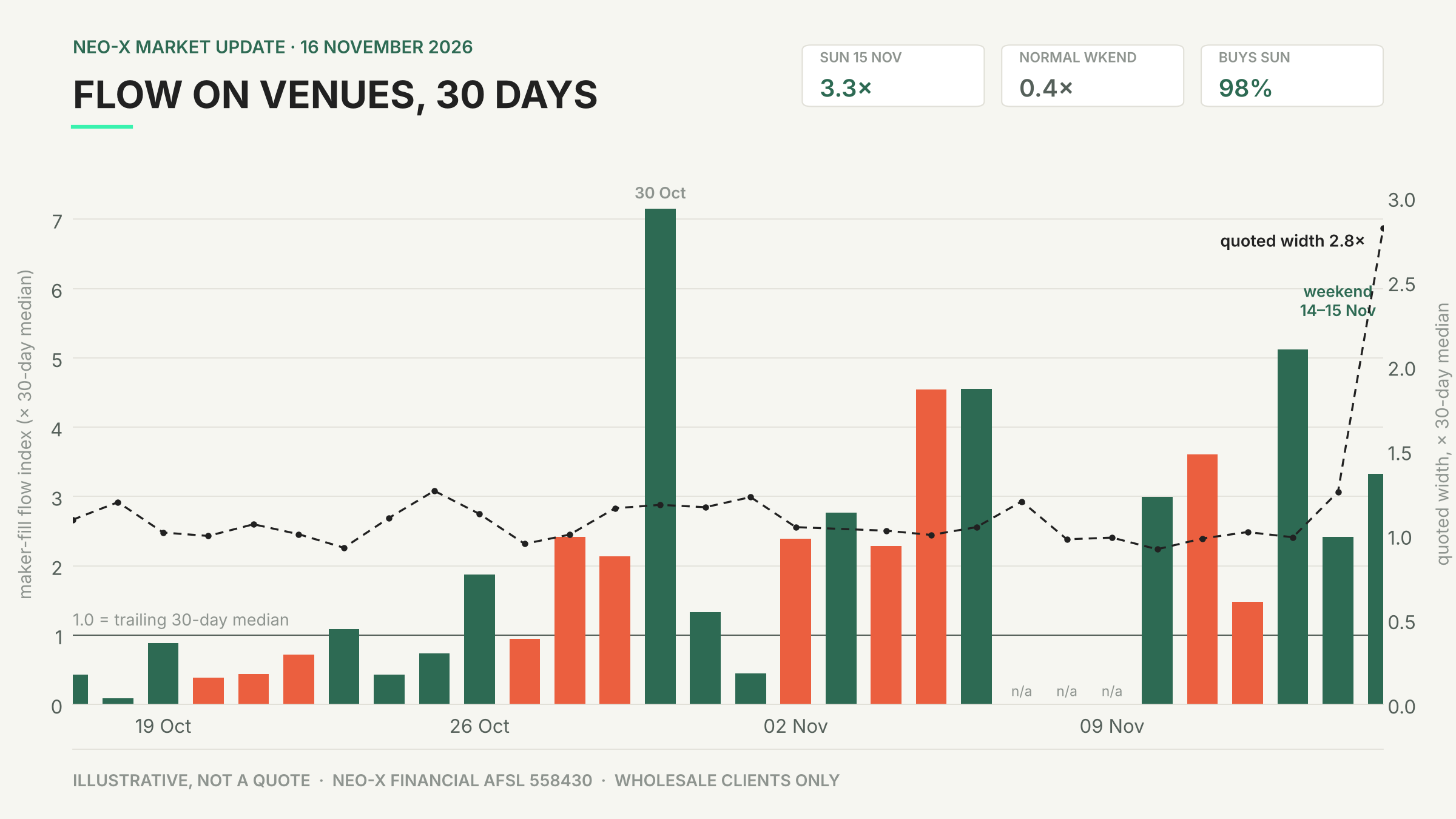
Flow on the venues. The chart reads the desk's maker fills across the exchanges it quotes on, each day as a multiple of the trailing-30-day median, bars coloured by whether the counterparties on the venues were net buyers from Neo-X, and the dashed line showing the desk's quoted width against its 30-day median. The weekday run of 10–13 November sat at 1.5 to 5.1 times the median with Friday 13 November the heaviest weekday in the window outside 30 October; counterparty buying was 68% of maker-fill notional on Tuesday and 71% on Friday, with the desk net sold to on Wednesday and Thursday. The weekend is the story. A normal Saturday or Sunday in the window ran at about 0.4 times the median with counterparties buying roughly 88% of the time, so weekend flow is usually light and one-way. Saturday 14 November ran at 2.4 times and Sunday at 3.3 times the median, five to eight times a normal weekend day, with counterparties buying 85% and then 98% of maker-fill notional. Quoted width, which held within about 5% of normal every weekday, widened to 1.3 times on Saturday and 2.8 times on Sunday, the widest reading in the window, and maker fills were 41% then 53% of the desk's total fills, the remainder being its own hedging as a taker. Venue A took 68% of weekend maker-fill notional on Saturday and 73% on Sunday against a weekday median near 56%, so the weekend demand concentrated on the largest venue rather than spreading across venues. Fills for 7–9 November were not captured and are shown as gaps.
Where the two desks met. The two reads agree on direction and differ on size. On Sunday both desks saw counterparties buying almost without exception, 98% on the venues and 100% OTC, at the same hours and against the same A$91,700–96,000 BTC/AUD prints. On the venues that buying was five to eight times a normal weekend; OTC it was a quarter of a normal day, because OTC tickets at the weekend were small and the desk's larger OTC flow all week was stablecoin-for-AUD, which does not touch the exchange AUD pairs. Put together: into the low, the bid for BTC/AUD came through exchange order books in size and through the OTC desk in small tickets, while the week's larger OTC flow was on the other side of the AUD leg, selling USDT for AUD. The desk quoting 2.8 times its normal width on Sunday and still being hit 98% on the bid side is the clearest single reading of how one-way the weekend was. Neo-X makes markets on local and international exchanges as principal and holds positions as a result; these are observations of the desk's own flow, not a view on direction.
What would change the read. First, a Monday US spot ETF print that turns positive after seven outflow sessions, which would suggest the weekend flush exhausted the forced sellers. Second, the weekday stablecoin-for-AUD selling reversing into USDT buying, which would be the clearest sign that the AUD leg rather than the crypto leg was driving last week's flow. Third, weekend-style small-ticket BTC/AUD buying persisting into the week at larger sizes, which would say the dip-buying was not only small-ticket. Fourth, the RBA minutes on Tuesday reading more hawkish than the 6–3 vote implied, which would support the AUD and change the AUD-leg maths on every USDT/AUD and BTC/AUD ticket.
Neo-X Financial Pty Ltd (ACN 674 294 127) holds Australian Financial Services Licence 558430. Client-facing services are provided by Neochain Pty Ltd, Corporate Authorised Representative 001320366. This update is for wholesale clients only within the meaning of sections 761G, 761GA and 708 of the Corporations Act 2001 (Cth) and is not intended for retail clients. Neo-X acts as principal, makes markets and may hold positions in the assets and instruments discussed. Digital assets and foreign exchange carry risk, including the risk of rapid and large price moves such as those described in this update. Figures are drawn from Kraken, Coinbase, Binance, the European Central Bank reference rates via Frankfurter, Trading Economics, the news sources cited in the text and Neo-X's own de-identified flow records, are approximate and illustrative, and are not quotes. Flow commentary describes the desks' own activity in relative terms and contains no client, counterparty, venue or notional information. Nothing in this update is financial product advice or a recommendation to deal. Contact sales@neox.au or (02) 9136 0264.


E: sales@neox.au
Ph: (02) 9136 0264
The Information contained herein, has been provided by the Neo-X Group for general purposes only, without any express or implied warranty of any kind, including warranties of accuracy, completeness, or fitness for any particular purpose. The information within constitutes general advice only and does not take into account your objectives, financial situation, or needs. It is not intended as, and does not constitute, personal financial advice, investment advice, tax advice, or any other professional advice; and is general in nature and is not specific to you or anyone else. Before acting on any of the information presented, you should consider its appropriateness to your circumstances and seek independent professional advice from a licensed financial adviser, accountant, or legal practitioner. You acknowledge that you use any and all information available on this site at your own risk.
RISK STATEMENT - Trading in foreign exchange, digital assets, and cryptocurrencies carries a high level of risk and may not be suitable for all investors. Prices can fluctuate significantly, and you may lose some or all of your invested capital. Past performance is not a reliable indicator of future performance. Anyone wishing to invest or trade should seek their own independent financial or professional advice and should only commit capital they can afford to lose.
Neo-X Financial Pty Ltd holds Australian Financial Services Licence No. 558430. Services are provided to wholesale clients only, as defined under sections 761G and 761GA of the Corporations Act 2001 (Cth).