News Centre

Neo-X Financial Granted Australian Financial Services Licence by ASIC
Neo-X Financial Pty Ltd (23 674 294 127), part of the Neo-X Group, has been granted an Australian Financial Services Licence by ASIC - for Wholesale Clients Only.
7 April 2026
Distributed ledger technology sits at the centre of one of the most consequential structural shifts in modern finance, evolving rapidly in real time.
We are pleased to announce to the market, that we have been granted an AFSL by ASIC. We're building the bridge between traditional financial systems and digital asset markets - delivering institutional-grade infrastructure that enables capital to move seamlessly across both environments within a strong regulatory framework.
"The AFSL reflects our unwavering commitment, not only to the standards required by the regulator, but also to those that we hold ourselves too internally. We welcome the new industry benchmark and look forward to broadening our service offering to a rapidly growing market."
Drew Kilroe - Chief Executive Officer
As the Australian market evolves, we remain focused on leading through change. We are well positioned to navigate the regulatory landscape and welcome a framework that enables constructive collaboration between industry and regulators.

OTC Trading
Neo-X will continue to expand its OTC offering. Providing liquidity solutions across more digital asset and fiat currency pairs. We will continue to refine our commercial offering, sharpening price, settlement speeds, and execution capabilities.
Trade Execution
Our execution model is channel agnostic. Clients access Neo-X through a combination of voice, chat, portal, or API best fits their workflow - execution quality, settlement standards, and service coverage are consistent across all of them.
Derivatives
Mitigate market exposures, secure cashflows, and create certainty through derivative strategies designed around the realities of our clients' businesses. Whether the exposure sits in cross-border payments, trading inventory, treasury operations, or digital asset positions, we structure forwards, swaps, and bespoke hedging products that match the underlying risk. The result is a hedging program that protects outcomes on terms that actually fit.

Non-Cash Payments
Our non-cash payment authorisation underpins how value moves through the Neo-X platform - across digital asset rails, fiat rails, and the cross-border flows that increasingly sit between them. We facilitate the settlement workflows that connect trade execution to client treasury, with controls embedded at every step. Every transaction running through our institutional-grade compliance infrastructure.
Client funds are held under our basic deposit authorisation while transactions are arranged and finalised, ensuring capital sits within a regulated framework throughout the entire trade lifecycle. For wholesale clients managing real flows - between counterparties, across borders, and across asset classes - non-cash payment capability is the difference between a desk that quotes prices and a counterparty that completes transactions. We've built the latter.

Neo-X Financial Pty Ltd (AFSL 558430) has been granted an Australian Financial Services Licence, available only to wholesale clients as per Sections 761GA and 708(10) of the Corporations Act 2001 (Cth) (Sophisticated / Wholesale Client). To serve these products, Neochain Pty Ltd (CAR No. 001320366) and NeoFX Pty Ltd (CAR No. 001320367) have been appointed as Corporate Authorised Representatives. We do not provide financial products or services to retail clients.

New Order Type: Conditional Orders
Perfect for investors and traders rotating between two currencies on a conditional price of another asset:
Sell currency XYZ if/when currency pair ABC hits your target price
Conditional Orders
Execute automatically when the market reaches your target.
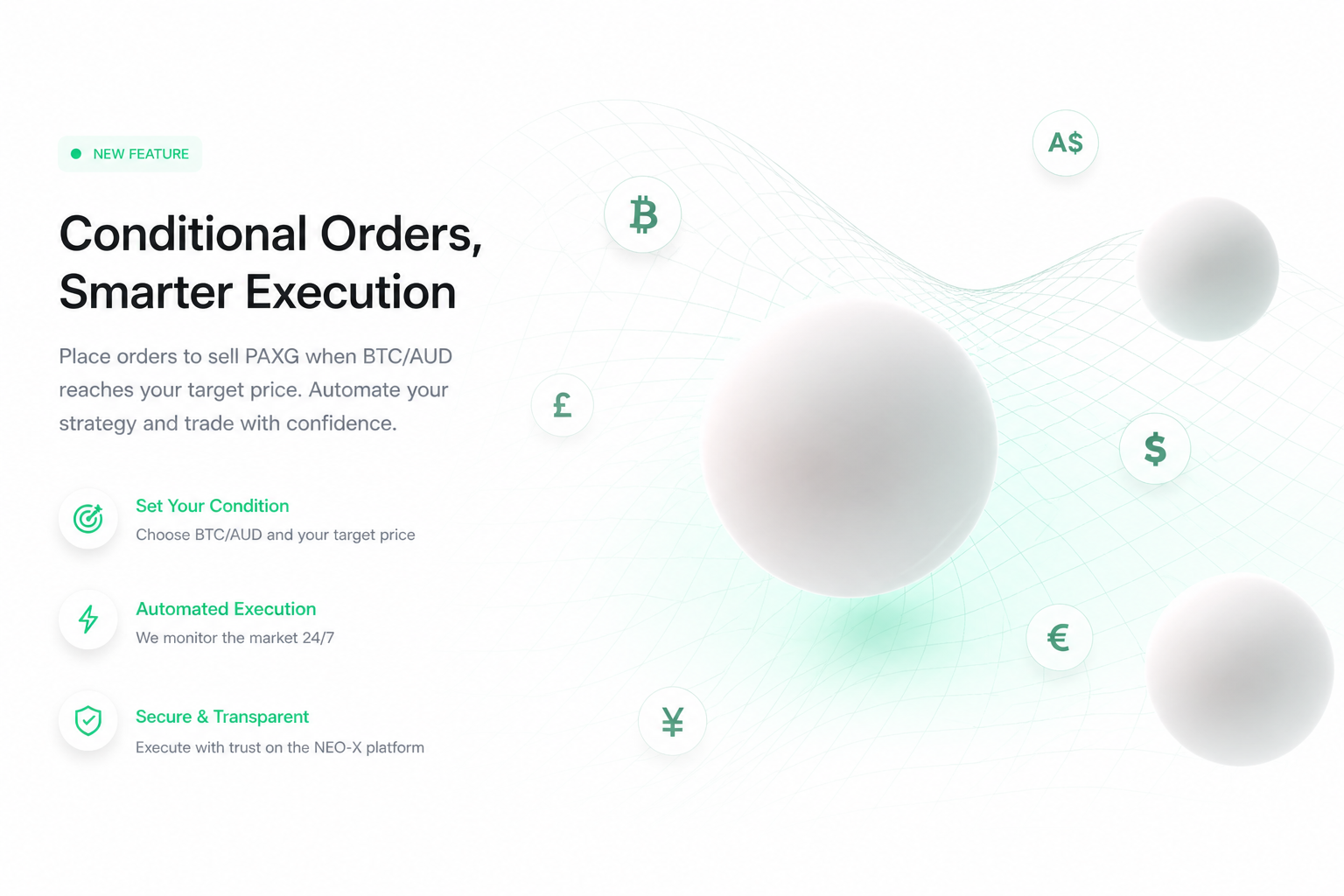
Conditional Orders allow you to predefine trading instructions that are activated when a specific market condition is met. For example, place an instruction to sell PAXG once BTC/AUD reaches a nominated price level - helping you execute strategy without constant market monitoring.
How it works
- Select the asset you want to buy or sell
- Define a trigger condition (e.g. BTC/AUD ≥ target price)
- Set your execution parameters
- Neo-X continuously monitors the market and automatically places the order once conditions are met
Designed for smarter execution, Conditional Orders help clients automate strategies, reduce manual intervention, and respond to market movements in real time.
Built for Smarter Execution
Conditional Orders extend Neo-X’s growing suite of execution tools, giving clients greater flexibility and control over how, when, and why trades are executed.
Alongside existing execution capabilities - including Market, Limit, TWAP and VWAP strategies - Conditional Orders allow clients to define trading actions based on external market conditions. Rather than reacting manually to price movements, clients can automate execution logic around predefined triggers and execution parameters.
Whether executing immediately, working larger orders over time, or automating strategy based on market events, Neo-X provides a flexible execution framework designed for institutional workflows and real-time decision making.


BitGo & Neo-X Custody Integration
Security-First Infrastructure
At the core of this partnership is BitGo’s qualified custody safeguarding assets with regulated cold storage, multi-sig security and $250M in insurance.
Seamless, scalable liquidity
BitGo and Neo-X provide deep liquidity and competitive execution offering institutions unparalleled efficiency for their trading strategies.
Global reach, local precision
BitGo’s global infrastructure and Neo-X strong presence in Australia means the best of both worlds for clients - global perspective with local understanding and enhanced support for Australian clients with international liquidity requirements. As digital asset markets mature, secure, regulated infrastructure is no longer optional.
Insurance
We've doubled our insurance coverage up to USD $500M, across two Custodian leaders; BitGo & Copper.
This partnership between BitGo and Neo-X empowers institutions to trade with confidence, backed by solutions built for performance, scale and reliability.


Clarity, at last?
Explainer: What does the Clarity Act actually do?
The Clarity Act is legislation that has not been required in approximately a decade. In Summary, it outlines what the regulator is in charge of and their powers accordingly. Furthermore, the bill divides digital assets into three categories and assigns each a regulatory home.
1. Digital commodities - defined as digital assets whose value is "intrinsically linked" to a functional blockchain - fall under the United States Commodity Futures Trading Commission. The CFTC would be granted exclusive jurisdiction over spot and cash markets for these assets, a substantial expansion of its authority. Exchanges, brokers, and dealers handling digital commodities would register with the CFTC as Digital Commodity Exchanges, Digital Commodity Brokers, and Digital Commodity Dealers.
2. Investment Contract Assets - remain with the Securities and Exchange Commission, preserving SEC authority over primary market crypto fundraising and tokens that retain securities characteristics.
3. Permitted payment stablecoins - already addressed in the GENIUS Act passed last year - sit with banking regulators, with the SEC and CFTC retaining anti-fraud jurisdiction over stablecoin transactions on registered venues.

A few specific provisions deserve attention
Stablecoin yield is restricted, not banned. The bill prohibits digital asset service providers from paying customers passive, deposit-like interest on payment stablecoin balances, but permits bona fide activity-based or transaction-based rewards under joint SEC, CFTC, and Treasury rules. This was the single most contested element of the negotiation and reflects a compromise between the crypto industry and the US banking sector.
What this means for the U.S. Market
Clear rules - unlock institutional participants that have been waiting on the sidelines for a decade. The clearest near-term effects:
Banking integration. Qualifying banks can hold and transact in digital commodities for the first time without bespoke OCC guidance or state-by-state interpretation. In a structural and durable environment.
Custody normalisation. The bill creates a qualified digital asset custodian standard, which gives institutional allocators a defensible framework for satisfying their own custody and fiduciary requirements.
Stablecoin product differentiation. With passive yield prohibited, the US market will likely bifurcate further between transactional stablecoins (USDC, USDT-style) and yield-bearing instruments structured as securities or tokenised money market funds.
Onshoring of liquidity. Industry advocates have framed this consistently as bringing market activity back into US jurisdiction. Whether the bill becomes law, and on what timeline, will materially shape where global liquidity sits in 2027.

Neo-X Statement
Australia is moving rapidly toward a more mature and fit-for-purpose digital asset regulatory framework. The Corporations Amendment (Digital Assets Framework (DAF)) Bill 2025 received Royal Assent on 8 April 2026, commencing on 9 April 2027 with a six-month transition period. The framework extends the existing AFSL regime to cover Digital Asset Platforms (DAPs) and Tokenised Custody Platforms (TCPs), while expanded AML/CTF obligations under AUSTRAC’s Virtual Asset Service Provider regime begin from 1 July 2026.
Despite a different regulatory architecture, Australia is converging with global markets by bringing custody into financial-services licensing, applying AML/CTF obligations as a baseline, and creating coordinated frameworks for tokenised assets and digital commodities.
Neo-X is well positioned for this transition. Operating under an Australian Financial Services Licence within the group, alongside Digital Currency Exchange and Independent Remittance registrations with AUSTRAC, Neo-X has proactively developed a dynamic, July-2026 travel rule-ready system. As regulation evolves, we remain focused on compliance, institutional-grade infrastructure, and delivering innovative FX and digital asset solutions for Australian wholesale businesses.
To learn more about Neo-X’s services, institutional liquidity, FX and digital asset markets, visit Neo-X
